The Art of Racing in the Wind Theaters in Beverly Hills
Life in Los Angeles in the 1930s
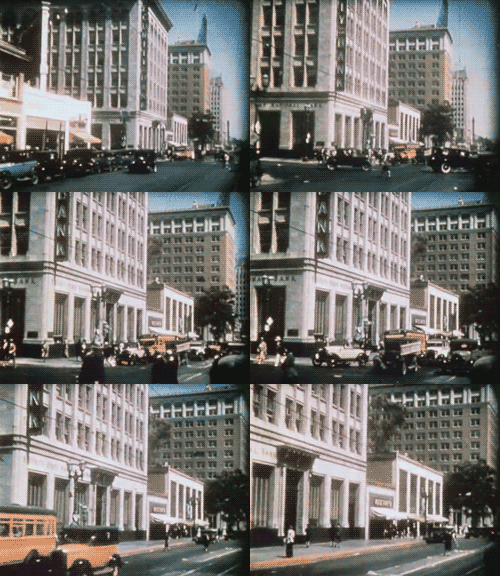
Above photo: Downtown Los Angeles in 1930.

The corner of Temple and Broadway, circa 1930.

Howe's "At the Sign of the Indian" Complete Motor Service, located at 7456 Melrose Artery, circa 1930. Proprietor: Leon D. Howe. (Photo: LAPL 00057621)

The Umbrella Service Station, Full general Petroleum Gas, circa 1930, one time located at 830 South La Brea in Inglewood. By 1946, the gas station was gone and a retail strip center was built on the site.

A Standard Oil Station located on the corner of Beverly and La Brea. The photo is undated, but possibly from the tardily 1920s to early 1930s since Pope and Burton Architects didn't open their Los Angeles office until 1927.

The seventeenth annual Los Angeles Motorcar Show held within the Shrine Auditorium's Expo Hall in Feb 1930. (Lensman: Art Streib / LAPL 00105791)

The Toonerville Trolley Sandwich Shop in one case located at 1635 W. Manchester Avenue. Out signs advertise tamales, chili, hot dogs, hamburgers, water ice foam, sodas, a sandwich special, and free coffee.

Dean Cornell (far left), and an assistant working on a mural for the Los Angeles Public Library from his Kensington Studio in London, circa 1930. Note the model with the basket on his head.

USC's "Tommy Trojan" statue, created by Roger North. Burnham, nearing completion in 1930. The iconic statue was completed at a cost of $10,000.

The Los Angeles Times' Hoe Super Production press consisting of 18 units in a line, which allowed for a new style of color printing in their daily newspapers. These machines were designed to print over 200,000 32-page newspapers in one hour. Postcard circa 1930.

The Corking (Josef) Satani, was a xix(ish) year-old member of the International Brotherhood of Magicians, who performed at the Los Angeles Coliseum on Apr 30, 1930. Co-ordinate to the Los Angeles Public Library, he was there to expose how these tricks were done. Satani came from Converse, Indiana, and was a popular entertainer with Boy Scouts, Kiwanis, Rotarians, etc.
In this photograph, he poses with picture show star Raquel Torres, left, and Frances Lee, correct, as he reveals the ol' write-a-hush-hush-question-down-on-a-piece-of-paper-and-I'll- tear-upwards-the-piece-of-paper-before-I-respond-the-question- with-the-crystal-brawl trick.
How was information technology done? Bait-and-switch on the pieces of newspaper.

Satani as well demonstrated how to levitate a table. The trick had to do with a special push button that released a latch on the tabletop that allowed a finger band to hook onto information technology as the ii arrows demonstrate.
He so convinced the innocent participant that their psychic energy was responsible for harnessing the paranormal to elevator the table.
Helping him was Frances Lee, who participated in Satani's act at the Fifty.A. Coliseum on Apr xxx, 1930.

Lastly, Satani demonstrates how to lift a table. Left to correct:Ned Connor;Thomas Barker, Deputy Labor Commissioner;Doc Joseph Jasin;B. Wayne De Hart, Deputy Reality Commissioner;Joseph Taylor, Chief of L.A. Detectives; andDt. Lt. Swan. Photograph dated: Apr 30, 1930.

Mines Field (afterwards the site of LAX) in 1930 during its dedication ceremony.
 A breathtaking view of Topanga Canyon from around 1930.

Dancers at Laguna Beach in Orange County, circa 1930.

Cooking school in Monrovia, circa 1930. (Huntington Library)

A 1930 billboard somewhere in Los Angeles. (LAPL 00104476)

The Los Angeles Urban center Hall in 1931. The landmark, designed by John Parkinson, John C. Austin, and Albert C. Martin, Sr., opened in 1928.

Adolph Hamer'southward grocery store at 4311 S. Figueroa Street in 1931. That's probably him standing in front.

A zany publicity stunt from 1931. A Goodyear stuffed named the "Volunteer" hovers higher up the Evening Herald edifice, located at 1111 South Broadway, to pick up a bundle of newspapers for a special delivery at city hall. (LAPL)
Figueroa Street Tunnels 1931 Framed Poster
 In November of 1931, the Florida 'Gators came to Los Angeles to play the UCLA Bruins at the Los Angeles Colosseum on Thanksgiving Day. The Bruins blanked the Gators 13-0.


Snow on the grounds of UCLA's Royce Hall on January 15, 1932.
![Sunset Blvd. and Laurel Canyon, circa 1932. Photographer: Harold A. Parker. [Huntington Library Archive] Bizarre Los Angeles](https://bizarrela.com/wp-content/uploads/2018/05/BLA_Sunset_Boulevard_Hollywood_Los_Angeles_1932.jpg)
Sunset Blvd. and Laurel Canyon, circa 1932. Photographer: Harold A. Parker. [Huntington Library Archive]


The McDonnell'due south Ever Swallow Restaurant at 301 North. La Brea Blvd. Not sure what the year is, merely it would have to be after 1932 in club for information technology to exist at that location. (California State Library)

The Garden of Allah Apartments at 8080 Sunset Blvd., circa 1930s. (LAPL)

Members of LAPD Captain Hynes' "Red" squad throwing a woman in the back of a car during an attempted political meeting at the Plaza on June 28, 1932. William Foster, the Communist political candidate for U.S. President at the fourth dimension, had legally tried to get a permit to speak at the Plaza merely had been denied. Frustrated past the lack of cooperation, he appear that he would be there at noon. The picture tells the rest of the story. (LAPL: 00039797)


Ii photos of Wilshire and Western, circa 1933.

Westwood Blvd. well-nigh Kinross in 1932. (LAPL 00104402)
 The Griffith Observatory under construction in 1933. If y'all look closely, you can see a man sitting on one of the steel girders. (LAPL 00063956)
 According to the USC Digitial Annal, this dwelling on Juan Street in sometime Chinatown was allegedly haunted in 1933. Notation the "For Rent" sign next to the door.


Before "Blackness Friday," there were almanacDollar Day sales in the major downtown department stores. These photos were taken on "Dollar Day," September 1, 1933.

Afton Place (between Fountain and Sunset), circa January 1934.

A window brandish at the Mullen and Bluett Clothing Store, located within the Walter P. Story Building (610 S. Broadway), circa 1934. (California Country Library)

From Olvera Street, circa 1934.
 A 1934 view of the quondam Temple Auditorium's box seats. (LAPL 00032526)
To read more, click hither: https://sites.google.com/
The auditorium was used for theatrical productions, also as Sunday morning church service. The venue later became the Combo Auditorium before it was demolished in 1985.

Oil field workers for Lane-Wells, based in Vernon, pose for a photo in 1934.

A film crew shooting the horse races at Santa Anita Park in 1935. (LAPL 00081704)
 California'sWhite Pikestaff Law unofficially launched in 1931 when the Braille Constitute began dispersing free white canes with ruby tips to legally blind people. When motorists saw these canes, they were supposed to yield the right-of-way. Visually impaired pedestrians could and so safely cross streets and thoroughfares.
While a few California cities recognized the right-of-way policy, many country politicians questioned the effectiveness of the white canes. Hoping to win political support, Frank Expect, the Plant's blind public relations director,demonstrated the cane'south effectiveness in front of politicians. These demonstrations took place in Oakland and Sacramento in 1933.
As a outcome, the California Country Legislature passed the White Cane Law, which went into result on Apr thirty, 1935.
Photo: 1935.

The Pan-Pacific Auditorium at 7600 Due west Beverly Boulevard. Information technology opened in 1935 simply was destroyed past burn down in 1989.
 Griffith Observatory after it was completed in 1935.
 Photographer Herman J. Schultheis snaps a photo of his married woman Ethel on the opening day of the Griffith Observatory, May 14, 1935. (Photographer: Herman J. Schultheis / LAPL 00068738)

Office of a fashion prove at Bullock'south Wilshire around 1935. (LAPL)

Lawn tennis anyone? Models working at a 1935 fashion bear witness at Bullock'due south Wilshire pose for a gag photograph. (LAPL 00073183)
![Photo is dated Oct. 19, 1935, with a caption that reads: "Celebrating the completion of a modern highway over one of Los Angeles' oldest trails, Sepulveda highway will be dedicated Sunday with gay fiesta where the highway joins with Sunset boulevard. Angeline Pagones is shown with her horse on the bridle path inspecting the new roadway. The highway follows a trail used ceturies [sic] ago by the Indians on their way to the sea." Bizarre Los Angeles.](https://bizarrela.com/wp-content/uploads/2018/05/BLA_sepulveda.jpg) Photo is dated October. 19, 1935, with a caption that reads: "Celebrating the completion of a modern highway over one of Los Angeles' oldest trails, Sepulveda highway volition be dedicated Sunday with gay fiesta where the highway joins with Sunset boulevard. Angeline Pagones is shown with her horse on the bridle path inspecting the new roadway. The highway follows a trail used ceturies [sic] ago by the Indians on their mode to the ocean."
Photo is dated October. 19, 1935, with a caption that reads: "Celebrating the completion of a modern highway over one of Los Angeles' oldest trails, Sepulveda highway volition be dedicated Sunday with gay fiesta where the highway joins with Sunset boulevard. Angeline Pagones is shown with her horse on the bridle path inspecting the new roadway. The highway follows a trail used ceturies [sic] ago by the Indians on their mode to the ocean."

A peaceful day at Hollenbeck Park (415 S St Louis Street) in the 1930s.

A point-of-view shot from an automobile traveling south along the Teddy Roosevelt Highway in the expanse of electric current-day Point Mugu Naval Base.
 The wreck of the "Lady Luck" at Rocky Point old in the 1930s. Rocky Bespeak is a part of Redondo Beach. (UCLA)

USC's Mudd Hall in the 1930s.

A vintage postcard of the downtownBullock's department store building, probably dating back to the mid to late 1930s.

It seems equally though every Woolworth's shop in America had "The earth's longest lunch counter." This is true in Delaware, Colorado, Minnesota, Texas…and California! The list goes on. Hither is a postcard of the Los Angeles store at 431 South Broadway, circa 1935.

The Eastern Columbia Building at 849 S. Broadway, c. 1930s.

A fortune teller stands exterior of her identify of business at the La Casa Santa Cruz adobe, once located at 728 N. Broadway. The building was an old throwback to Sonora Town and was formerly owned by Ysabel Santa Cruz, who had purchased information technology from Benito Valle in 1864. The photo was taken in 1936. (LAPL: 00067652)

Members of El Teatro Mexico in 1936, hanging out in the Childs Grand Opera House'southward light-green room, where Sarah Bernhardt once waited to go on stage in 1891.
The photo was taken on Apr 8, 3 days after the 1884 theater building airtight. Once located at 110 S. Main St., it was quickly torn downward to brand a parking lot. (LAPL 00036861)

The prop room of the Childs M Opera Business firm in April of 1936. The items belonged to its last tenants, the El Teatro Mexico. (LAPL 00036860)
 An art deco-dressed adult female (Fifty. Taylor) at Santa Anita Park in 1936.
The racetrack was the brainchild of Hollywood producer Hal Roach and Dr. Charles Strub, a San Francisco dentist, who formed the Los Angeles Turf Club in 1933 in order to enhance coin for the track. Santa Anita Park, designed by Gordon B. Kaufman, opened on Tuesday, December 25, 1934. The opening solar day's attendance was 30,077 visitors. The admission price was .fifteen cents.

"Open up Air Fish Market" at Newport Beach, 1930s.

A 1936 custom-fabricated, three-wheel automobile for Arrowhead Bound Water. Lensman: J.H. McCrory. Photo: 50.A. Times.
The photo can exist found here: http://framework.latimes.com/…/06/eleven/arrowhead-teardrop-automobile/
More info can exist found hither: http://www.hemmings.com/…/sto…/2012/03/01/hmn_feature28.html
 2 salesmen for Halsco Land Yacht (3587 Beverly Boulevard) demonstrate the efficiency and condolement of one of its 1936 travel trailers. (Lensman: Fine art Streib / LAPL 00044861)

Western Avenue traveling southwest every bit it approaches 73rd street. Photo date: 1936. (LAPL 00104404)
 From the Los Angeles Times article "Metropolis to Bonfire Tonight in Vast Light Festival," dated October 9, 1936:
Like a streak of lightning – flashing 260 miles across mountains, deserts, and farmlands – power from Hoover Dam will be brought to Los Angeles at seven:36 p.chiliad. today, flooding the downtown section with illumination vieing [sic.] that of the lord's day and opening a commemoration which is expected to dra due west thousands of persons into the concern district.
Shining with a radiance equal to that of vii,200,000,000 candles, the downtown area will be bathed in the greatest illumination that has ever been flooded over a city since history began, according to electrical and illuminating engineers who have been preparing for the celebration for several months.
Photograph: UCLA

Crossing Spring Street in 1937.
(Photographer: Herman J. Schultheis/ LAPL)

Pedestrian traffic on Seventh Street at Hill in 1937. Photographer: Herman J. Schultheis / LAPL 00097819

A four-door 1937 Studebaker is parked in front of a women's clothing store somewhere in Los Angeles.
 Ii icons of Los Angeles: the Brown Derby Restaurant on Wilshire and the Administrator Hotel across the street. From 1937. Both a retentivity.

An elephant with the Clyde Beatty Circus gets a wash from Teddy Metcalfe near the intersection of Grand and Wilshire, circa May of 1937. (LAPL)

Exterior the (lost)Imprint Theatre at 458 S. Main Street in June of 1937.
(Photographer: Herman J. Schultheis/ LAPL)

Alameda Street in Sometime Chinatown, c. 1937. Lensman: Herman Schultheis. (LAPL 00097498)

The intersection of Marchessault Street (now part of Sunset Blvd) and Los Angeles Street (correct).


Westwood Village, circa 1937.

A dandy vintage photo of Cabrillo Beach in San Pedro, circa 1937.

A carnival barker for theDreamland Circus Side Show entertains a crowd of people attending the 1937 Los Angeles County Fair in Pomona. (Photographer:Herman J. Schultheis / LAPL 00097289)

A sideshow carnival performer with the Parisian Follies dancers at the 1937 Los Angeles County Off-white. (Lensman: Herman J. Schultheis/LAPL) Bizarre Los Angeles.
 "Oil Island" was located on La Cienega Blvd., between Beverly and third Street. The wooden derrick was originally synthetic in 1907 in the middle of a edible bean field. When the city extended La Cienega to Sunset Blvd., there was a dispute over the cost of the well, so the metropolis congenital around information technology. In 1946, an agreement was struck and the well was dismantled.

The Mona Lisa Restaurant was once located at 3343 Wilshire Blvd., east of the Gaylord Apartments and across the street from the Ambassador Hotel bungalows. The photo was taken in 1937. (LAPL 00008603)

Santa Monica Blvd. (between N. Doheny and Robertson) in 1937.
 In late November of 1937, a mountain near the Figueroa Tunnels in Elysian Park collapsed, knocking down power lines and sending boulders crashing down a hillside onto Riverside Bulldoze and into the Los Angeles River bed. The noise and sight of falling boulders created quite a spectacle over several days. And then much so that i Angeleno mounted a telescope on his car and then that people could witness the mount's plummet from a safe altitude. Photographer: Herman J. Schultheis.

A wet day in Jan 1938. The photo was taken on the 800 block of Hill Street. Lensman: Herman J. Schultheis / LAPL 00100752

The intersection of Eighth and Colina in January 1938. The RKO Hillstreet Theatre (since demolished) is in the background. Photographer: Herman J. Schultheis/ 00100753)

The Los Feliz Boulevard Bridge from Riverside Bulldoze looking northeast shortly after half of information technology was destroyed by Los Angeles River floodwaters in 1938. The Police Officer, left, is unknown. The human on the correct is Van Griffith, son of Col Griffith J. Griffith, who gave Griffith Park to Los Angeles.

A slum in L.A., circa 1938. The address appears to be 311 N. Mission Road. The small room with the open door is a shoe repair shop. (UCLA)

The Vista Theatre at 4473 Sunset Drive, c. 1938. Lensman: Herman J. Schultheis / LAPL 00102309)

The intersection of Whittier Boulevard and Soto Artery (in Boyle Heights) facing southwest. The photo was taken in 1938. (LAPL: 00104448)

Vermont Avenue facing southeast. The cross street is Wilshire Blvd. Date: 1938. (LAPL: 00104333)

The Cafe Trocadero (8610 Sunset Blvd.) in 1938. (LAPL 00045344)
 June eight, 1938. Hula dancers perform inside the Los Angeles City Council Sleeping accommodation accompanied by a ukulele and guitar orchestra. (LAPL)


September 7, 1938. Jitterbugging juveniles disrupt the L.A. Metropolis Quango to promote the American Legion's "Jitterbug" contest at Gilmore Stadium.

A billboard in a section of Old Chinatown, circa 1938. (Academy of California)

A 1938 burn engine parked in forepart of the LAFD Fire Station No. fifty, circa 1948. The station was once located at 1524 Winfield Identify.

Broadway between 4th and fifth streets in 1938.
 A dance hall that one time existed at 245 South Vermont Artery from 1925 to 1939.
Information technology was originally named El Patio. By the fourth dimension this 1938 photo was taken, nevertheless, it was chosen the Palomar Ballroom. The following yr, a burn destroyed the building.
(Lensman: Herman J. Schultheis / LAPL 00100741)

The Los Angeles Constabulary Motor Patrol in 1938.
 Ice skating at the Tropical Ice Gardens at Westwood Village in 1938 (the year that it opened). The outdoor rink was once located on the southwest corner of Gayley and Weyburn Avenues.

The Los Angeles Car Show at the Pan-Am Pacific Auditorium in Nov 1938. (LAPL 00105773)
 "Fandangos and salami were offered cheek by jowl at the opening of Rancho Pico, a super-market in Los Angeles. Super-markets, fearing that their customers have become too jaded to be attracted by conventional searchlight displays, at present put on flooring shows with their weekend sales. The Otto K. Olesen Illuminating Co., which supplies the searchlights, also produces the floor shows." — LIFE Mag, November 1938.

Ernie'due south 5¢ Café, in one case located at 806 E. 5th Street, circa 1939. (Photographer: Burton O. Burt/ LAPL 00068906)

Before the Las Floristas Headdress Ball took on its nowadays name, the social event was called the Bal de Tete, started by the Junior Flower Society. Hither is the second annual Bal de Tete, which took place in tardily Apr 1939 at the Victor Hugo, a trendy Beverly Hills restaurant once located at (or near) 235 Northward. Beverly Drive. Notice how small the headdresses were back then? (LAPL 00044842)
 The second floor of the I. Magnin shop in 1939. Its address was 3240 Wilshire Boulevard, Los Angeles, CA 90012

The intersection of Vermont Artery and 3rd Street, facing north in June of 1939. LAPL: 00104345.

Flower Street, south of 8th, circa 1939. (LAPL 00104226)

Dancers do the jitterbug at City Hall's portico in 1939. It was a publicity stunt to go Los Angeles Mayor Fletcher Bowron to nourish the International Jitterbug Championship at the Los Angeles Coliseum. (LAPL)
 Looking north on Hill Street from fifth in 1939. (Photographer: Dick Whittington / USC Digital Archive)
 Dorothea Lange's famous photograph of two men walking to Los Angeles during the Great Depression, circa 1939.
 The interior of a Los Angeles Pacific Electric Streetcar in December 1939. LAPL

derossettspito1964.blogspot.com
Source: https://bizarrela.com/2018/05/life-los-angeles-1930s/
0 Response to "The Art of Racing in the Wind Theaters in Beverly Hills"
Post a Comment