Gone With the Wind Clip Art Ashley and Melanie
In her monograph on the film for the BFI Motion picture Classics series, Helen Taylor writes ofGone with the Wind'south director, Victor Fleming, that "he returns repeatedly to that familiar trope of southern picture show — the staircase — every bit site of pregnant action, likewise as a suggestive thematic link betwixt the everyday and the nocturnal, linking social relationships and sexual desire, reason and passion." For what they signify, the four primary sets of stairs in the film serve equally the perfect stage for Scarlett O'Hara'south story, her rises and falls. Not only are they a fine visual aid for the narrative engine, just in their diverse designs (past art director Lyle Wheeler) they make statements most the characters almost closely associated with them.
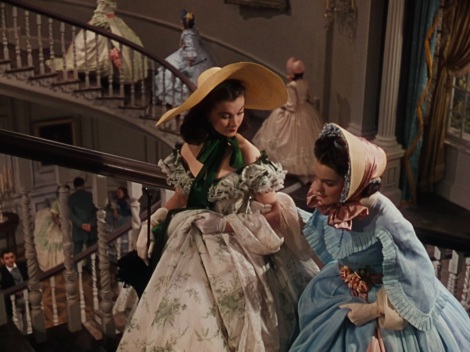 The first, almost ornate staircase is found at the Twelve Oaks plantation, home of Ashley Wilkes (Leslie Howard). A wide, curving stair that splits in two opposite directions halfway upward, information technology's a luxurious structure, cute for its own sake. More and then than Tara, the O'Haras' plantation, Twelve Oaks is the symbol of antebellum splendor, and the staircase is its centerpiece. This is the earth that is about to be lost when war, emancipation, and General William Tecumseh Sherman come around, a kind of opulence that will be swapped for more than functional, difficult-nosed designs. Here is the site of one of the smashing graphic symbol entrances in motion picture history, when Scarlett (Vivien Leigh) looks down at a homo staring up at her. He's the notorious Rhett Butler (Clark Gable), leaning on the handrail at the landing, a worldly grinning on his face. Immediately, the stairs add visual involvement to some necessary expository dialogue.
A footling afterwards, having been rebuffed in her annunciation of love to Ashley, Scarlett will collect herself and climb the stairs again at a crucial moment. In a sweeping shot from the cardinal landing, taking in the mansion'southward entrance hall, nosotros see Scarlett, untouched by history equally it flares up from all directions, as well absorbed in her private quandary to and then much as expect around. Then the callow Charles Hamilton (Rand Brooks) fills her in on the land of the marriage, and she impulsively enters her start matrimony. The moving-picture show having just crossed the kickoff half-60 minutes mark, this is the final nosotros'll see of Twelve Oaks until about an hour later, when the home has become a blasted-out husk. The staircase is all the same mostly intact, but it at present leads nowhere. The globe has clearly changed, but we must look to other staircases to find how Scarlett has changed with information technology.
 In her hopeless pursuit of Ashley, Scarlett spends some fourth dimension in Atlanta with his married woman Melanie (Olivia de Havilland). The more modest (though not without its own ornamentation) home of Aunt Pittypat (Laura Hope Crews) is where the next staircase is located. It's a simple, directly and narrow rise directly away from the front door, coming to a landing and then continuing in the opposite management. There simply isn't room to become lost in ane'due south thoughts on these stairs — not without bumping into someone else, that is. And then this staircase becomes the arena where Scarlett and Prissy (Butterfly McQueen) butt heads while Melanie goes into labor. Having tried and failed to go a real doctor to come up help (since the casualties of war have become overwhelming), the already exhausted Scarlett steels herself to take accuse. Her right hand clutching the railing, she takes slow, methodical steps in respond to Melanie'south cries. Her motivations haven't really changed, simply now she bears the full weight of the situation by herself and doesn't bend. After the nascence, she leads the flight from the house, descending the stairs with a lantern, Rhett having arrived to behave the debilitated Melanie in his arms, just before Atlanta begins to fire.
 The staircase at Tara is almost as simple every bit Aunt Pittypat'south, nigh a mirror prototype. It's important that we don't get a really expert look at it until after the intermission. With her mother dead and her male parent no longer of sound mind, Scarlett becomes head of the household. The space belongs to and is a reflection of her. Only i pregnant outcome occurs here. A Wedlock deserter (Paul Hurst) arrives to swipe some of the family'south belongings, and he meets Scarlett standing just below the key landing of the stairs. He starts walking up to her in a menacing fashion merely fatally underestimates her preparedness. The quick series of cuts — the soldier's eyes widening, the gun pointing direct at the camera, the soldier looking straight at the camera every bit the gun goes off, Scarlett'due south squinting reaction, the bloody face, the body falling — make for the most visceral moment of violence in a war motion picture that doesn't evidence whatever battles. Melanie, still recovering from childbirth, arrives a moment later, sword in tow. In this scene, nigh halfway through the movie, Scarlett finally gains respect for this woman who married her beloved Ashley.
 Gone with the Wind is the capstone of 1930s Hollywood picture palace in that it depicts the ascension from destitution and despair to abundant wealth in sumptuous detail. Scarlett'southward maneuverings, including a second loveless spousal relationship enacted every bit a business venture, culminate in the crowd-pleasing wedlock with Rhett, who already had "millions." The Butler-O'Hara residence in postwar Atlanta is stunning and elaborate, nearly rivaling Twelve Oaks, though, of course, without the history. The cherry staircase, in detail, is an entirely different kind of embellishment, very wide just climbing straight ahead and with no intermediary landings. All the familiar emotional resonances of the colour red come into play hither. Rhett and Scarlett have information technology out over her continued pining for Ashley. In the middle of the dark, he forcefully carries her up the stairs into the darkness, ane of the most fraught "fade to black" moments of Hollywood's Golden Age. Then, starting time the string of crises of the film's final half-hour, Scarlett accidentally falls downwardly those stairs and miscarries. The melodrama starts to hitting a fever pitch, just the emotional meridian doesn't come with any one issue, but with the bawling study of Mammy (Hattie McDaniel) to Melanie equally they go up the stairs, filling her in on the final, devastating blow to the Butler-O'Hara marriage. Last of all, when Rhett leaves the house for practiced, Scarlett returns to the staircase, stretching herself out on the offset steps. Only recently take I plant the ending of the film especially satisfying, simply it actually is a stirring emotional shell. Scarlett's rebirth volition come when she returns home and starts over, once over again.
There are many symmetries and recapitulations over the nearly four hours ofGone with the Wind. Producer David O. Selznick and production designer (a title that didn't exist before this film) William Cameron Menzies deserve a lot of credit for wrangling a coherent visual style from such a complicated and troubled production. Lyle Wheeler's stairs aren't going to be the starting time affair anyone remembers from this film, just it'southward impossible to forget the events that happen on them. Every bit elaborate constructions, they serve equally adequate symbols for the picture show itself, the great epic of the American South that was shot entirely in California, with matte paintings and facades but also with a full-scale conflagration. If the stairs could talk, they'd tell you something near birth and death, lust, rage, terror, regret, and resolve. They do talk, in a manner.Gone with the Wind wouldn't be the miracle it is otherwise.
derossettspito1964.blogspot.com
Source: https://geppettosclocks.wordpress.com/2017/03/31/the-staircases-of-gone-with-the-wind/
0 Response to "Gone With the Wind Clip Art Ashley and Melanie"
Post a Comment